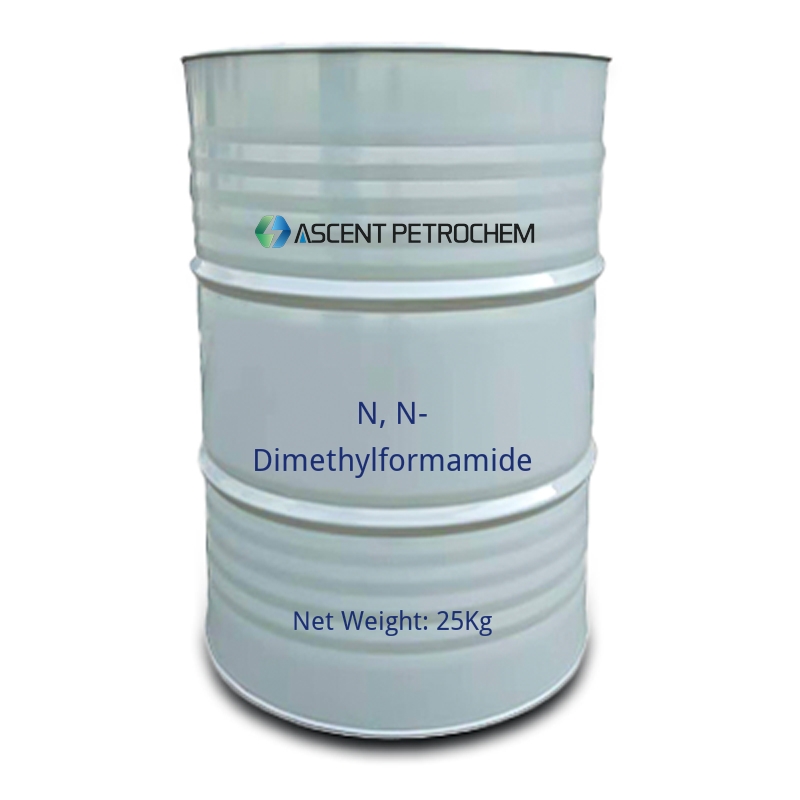
N,N-Dimethylformamide
- Product Name: N,N-Dimethylformamide
- Factroy Site: Yudu County, Ganzhou, Jiangxi, China
- Price Inquiry: sales6@ascent-chem.com
- Manufacturer: Ascent Petrochem Holdings Co., Limited
- CONTACT NOW

- N,N-Dimethylformamide is typically used in formulations when solvent polarity and water content must be controlled within specific ranges.
| HS Code | |
| Product Name | N,N-Dimethylformamide |
| Synonyms | DMF; N,N-dimethylmethanamide; formdimethylamide; dimethylformamide |
| Cas Number | 68-12-2 |
| Ec Number | 200-679-5 |
| Molecular Formula | C3H7NO |
| Molecular Weight | 73.09 g/mol |
| Appearance | Colorless liquid |
| Odor | Faint, characteristic amine-like odor |
| Boiling Point | 153 °C |
| Melting Point | -61 °C |
| Density | 0.944 g/cm3 at 20 °C |
| Solubility | Miscible with water and many organic solvents |
| Flash Point | 58 °C closed cup |
| Vapor Pressure | 0.36 kPa at 20 °C |
| Refractive Index | 1.4305 at 20 °C |
| Viscosity | 0.92 mPa·s at 20 °C |
| Autoignition Temperature | 445 °C |
| Explosive Limits | 2.2–15.2% v/v in air |
| Logp | -1.01 |
| Ph | Neutral |
As an accredited N,N-Dimethylformamide factory, we enforce strict quality protocols—every batch undergoes rigorous testing to ensure consistent efficacy and safety standards.
| Packing | N,N-Dimethylformamide is packaged in 1 L amber glass bottles with PTFE-lined caps, securely sealed, UN-approved, and hazard-labeled for transport. |
| Container Loading (20′ FCL) | 20′ FCL loading of N,N-Dimethylformamide in UN-approved steel drums: palletized, secured, sealed, labeled, and documented under IMDG hazardous cargo rules. |
| Shipping | N,N-Dimethylformamide is shipped as UN2265, Class 3 flammable liquid, Packing Group III, under proper shipping name DIMETHYLFORMAMIDE. Use approved UN packaging, flammable-liquid labels, SDS, and emergency response information. Follow IATA/IMDG/49 CFR rules; keep away from ignition sources. It is toxic, avoid skin contact/inhalation. Trained handlers and compliant documentation are required. |
| Storage | Store N,N-dimethylformamide in a cool, dry, well-ventilated flammable-liquid cabinet, away from heat, sparks, flames, strong oxidizers, acids, and bases. Keep containers tightly closed, properly labeled, grounded, and protected from moisture. Use secondary containment and local exhaust ventilation. Avoid contact with aluminum and other incompatible materials. Store only in original or compatible containers. Follow local regulations and manufacturer guidance. |
| Shelf Life | N,N-Dimethylformamide has a shelf life of about two years when stored sealed, cool, dry, and protected from moisture and light. |
How Does Bath DMF Concentration Govern Coagulation Uniformity in Wet-Process Polyurethane Lines?
Polyurethane wet-process coating lines that employ N,N-dimethylformamide (DMF) as the primary solvent are constrained by the ternary exchange rate between solvent, water, and PU resin. Production-scale operations typically prepare a coating solution in which PU solids account for 25–40 wt% and DMF constitutes the balance, with DMF-to-MEK ratios between 70:30 and 100:0; Brookfield LVT viscosity measured at 25°C with spindle 3 at 12 rpm falls between 4,000 and 10,000 mPa·s. The working viscosity is adjusted by incremental DMF addition at high-shear mixing stations equipped with Cowles blades operating at tip speeds of 15–25 m/s; no more than 5 vol% of DMF is added per 10 min interval to avoid local polymer precipitation. The coagulation bath is maintained at 15–25 wt% DMF and 20–40°C; when bath DMF exceeds 30 wt%, polyurethane surface porosity increases sharply and adhesion to release paper decreases, a failure mode observed on transfer coating lines producing synthetic leather for automotive interiors. The downstream process is a knife-over-roll coating line followed by coagulation in a water-DMF bath, washing in a counter-current cascade of 4–6 tanks at 30–50°C, drying at 80–120°C, and final winding; DMF is recovered from the process water and coagulation bath via triple-effect evaporation and rectification to 99.5 wt% purity before recycle. DMF is hygroscopic, so storage vessels are blanketed with dry nitrogen when relative humidity exceeds 60% to keep water below 0.1 wt%. Compliance for this application is governed by EU Directive 2022/431 for occupational exposure limits (DMF TWA 15 mg/m³, STEL 30 mg/m³) and REACH Regulation EC No 1907/2006 Annex VI Table 3.1 classification as Repr. 1B H360D; finished synthetic leather articles are assessed under ISO 3376:2020 for tensile strength and ISO 11644:2009 for finish adhesion. The terminal product types include polyurethane synthetic leather used in automotive seat covers, footwear uppers, upholstery, and coated textiles for industrial protective apparel.
| DMF content (wt%) | PU solids (wt%) | Viscosity (mPa·s, spindle 3, 12 rpm) | Coagulation bath DMF (wt%) |
|---|---|---|---|
| 70 | 30 | 5,200 | 18 |
| 75 | 25 | 3,400 | 16 |
| 80 | 20 | 2,000 | 14 |
| 85 | 15 | 1,200 | 12 |
Acrylic Fibre Spinning: DMF-Soluble PAN Dope and Diffusion Control
The use of DMF in wet spinning of acrylic fibres is centred on its ability to dissolve polyacrylonitrile (PAN) copolymers with molecular weights in the range of 70,000–120,000 g/mol. The spinning dope is prepared by dissolving 20–28 wt% PAN powder in DMF in a jacketed reactor at 60–80°C under nitrogen blanketing; dissolution is followed by plate-and-frame filtration through 10–20 µm absolute media and vacuum deaeration at 50–80 kPa absolute to remove bubbles. The coagulant bath contains DMF, water, and sometimes a small amount of solvent aid; commercial lines commonly maintain 30–50 wt% DMF in the bath at 10–25°C to slow solvent extraction and produce a uniform radial structure. The fibre is extruded through spinneret capillaries of 50–80 µm diameter at jet velocity 5–15 m/min, then drawn 1.5–6.0 times in a multi-stage hot water/steam drawing unit; drawing tension is monitored by inline load cells and maintained below 0.25 cN/dtex to prevent fibrillation. Critical operational boundaries include DMF moisture content below 0.1 wt% to prevent PAN precipitation in the dope and avoid spinneret hole blockage from gel particles; batch-to-batch variation in PAN comonomer content can shift the coagulation rate, requiring adjustment of bath DMF by ±5 wt% to keep filament breakage below 1 break per 10,000 m. DMF is hygroscopic, so storage tanks are blanketed with dry nitrogen when relative humidity exceeds 60%. Compliance requirements for fibre production include the OEL under Directive 2022/431, REACH classification as Repr. 1B, and finished fibre residual DMF limits assessed by solvent extraction and gas chromatography according to buyer specifications, with 100 mg/kg often used as a practical upper limit in apparel-grade acrylic fibre. Fibre classification follows ISO 2076 for man-made fibre generic names. End product types are acrylic staple fibre for apparel, blankets, outdoor textiles, and precursor tow for carbon fibre conversion.
When DMF Loadings Exceed 7:1 Solvent-to-Feed Ratio in Butadiene Extractive Distillation
Extractive distillation of C4 raffinate using DMF as the entrainer relies on the solvent’s ability to suppress the relative volatility of butanes and butenes relative to 1,3-butadiene. The solvent-to-feed ratio on commercial DMF units is typically 4:1–7:1 by mass; at ratios above 7:1, reboiler energy demand rises non-linearly and column differential pressure may exceed design limits without gain in polymer-grade butadiene purity. DMF entering the extractive distillation column is dried to 99.5 wt% minimum purity with water below 0.1 wt%; residual water above this level accelerates hydrolysis to dimethylamine and formic acid, which are corrosive to carbon steel reboilers and can catalyse polymerisation of diene streams. Column overhead pressure is maintained at 0.4–0.6 MPa gauge, and the extractive distillation column bottom temperature is held between 150–170°C; above 170°C DMF thermal degradation is observed, as evidenced by increased dimethylamine concentration in the recovered solvent. The process configuration includes a pre-separation C4 feed dryer, extractive distillation column with solvent preheater, a solvent recovery column operating at reduced pressure 0.02–0.04 MPa absolute, and a post-distillation wash step for polymer-grade butadiene with caustic or water. Polymer-grade 1,3-butadiene is produced at 99.6 wt% minimum purity with total acetylenes below 50 mg/kg and dimethylformamide residue below 1 mg/kg in some specifications. Compliance for butadiene product quality is commonly assessed by gas chromatography according to ASTM D2593-19; process safety thresholds for DMF exposure follow EU Directive 2022/431. The exact purity gain beyond 7:1 solvent-to-feed ratio is batch-specific; published data for this specific configuration is limited. End product types are polymer-grade 1,3-butadiene for styrene-butadiene rubber, polybutadiene rubber, and ABS resin feedstocks.
| Solvent-to-feed ratio (mass) | DMF water content (wt%) | Extractive column bottom temperature (°C) | Polymer-grade butadiene purity (wt%) |
|---|---|---|---|
| 4.0:1 | 0.08 | 152 | 99.7 |
| 5.5:1 | 0.06 | 158 | 99.8 |
| 7.0:1 | 0.05 | 165 | 99.8 |
Pharmaceutical peptide synthesis operations that retain DMF as both coupling solvent and chromatographic modifier operate under a narrow residual-solvent control window. The most critical compliance boundary is defined by ICH Q3C(R9): DMF is a Class 2 solvent with a permitted daily exposure of 8.8 mg/day and a concentration limit of 880 ppm in the finished drug product. In solid-phase peptide synthesis, the resin swelling step typically uses 10–20 mL DMF per gram of aminomethyl polystyrene or PEG-based resin; coupling reactions use activated amino acid solutions at 0.2–0.5 M in DMF with HATU or HCTU as coupling agents and N-methylmorpholine as base. The Fmoc deprotection step uses 20 vol% piperidine in DMF, which produces dimethylamine as a degradation byproduct; this amine can prematurely remove Fmoc from the growing peptide chain if batch hold times exceed 30 min at 25°C. Purification of the cleaved peptide is carried out by preparative reversed-phase HPLC with a mobile phase containing 1–5 vol% DMF as a modifier to improve solubility of hydrophobic sequences; acetonitrile is the primary organic modifier, and DMF concentration is limited by backpressure and UV absorbance at 214 nm. Equipment used includes jacketed solid-phase reactors with bottom sintered frit, overhead agitator, nitrogen blanket, and inline conductivity probes to confirm washing efficiency; final residual DMF in lyophilised peptide API is quantified by gas chromatography with headspace sampling per USP 467. The operational boundary at relative humidity above 60% requires dry nitrogen blanketing of DMF storage to keep water below 0.1 wt% because water promotes carbodiimide hydrolysis during activation. Terminal product types are therapeutic peptides, peptide APIs, and peptide-based diagnostic reagents.
In synthesis of sulfonylurea and carbamate pesticide actives, DMF functions as a polar aprotic reaction medium where nucleophilic substitution and condensation reactions are accelerated by high dipole moment and aprotic character. A typical batch reactor charge uses 2–10 volumes of DMF relative to the limiting intermediate; reactions are conducted at 50–90°C under a nitrogen atmosphere, with DMF water content below 0.1 wt% to prevent hydrolysis of isocyanate or sulfonyl chloride intermediates. Upon completion, the reaction mass is distilled under vacuum to recover DMF for recycle at 99.5 wt% purity, followed by water quench and crystallisation of the technical active; the recovered solvent is checked for dimethylamine content below 100 mg/kg because amine impurities can react with isocyanate groups in subsequent batches. Equipment includes glass-lined reactors, overhead condensers, wiped-film evaporators for DMF recovery, and fluidised bed dryers for technical material; batch-to-batch variation in solvent quality is a known contributor to colour impurities in technical active crystal. Compliance for this application is anchored to EU Directive 2022/431 for worker exposure, REACH Regulation EC No 1907/2006 classification, and the relevant FAO/WHO specification for the particular active ingredient, which sets impurity limits but does not define DMF residue in technical material universally. Published data for specific active ingredient configurations is limited. Finished product types include technical-grade herbicides and insecticides that undergo further formulation into water-dispersible granules or suspension concentrates.
Industrial paint stripping formulations that include DMF as a primary solvent are used for removing crosslinked polyurethane and epoxy coatings from steel and aluminium components in maintenance and overhaul operations. The immersion bath is typically maintained at 20–40°C with DMF content between 30–60 wt%, supplemented by a corrosion inhibitor package at 0.5–2 wt% to protect aluminium substrates from alkaline degradation products; thickening agents such as hydroxypropyl cellulose may be added at 1–3 wt% for brush-grade variants. The stripping mechanism is polymer swelling followed by adhesion loss; for epoxy coatings with high crosslink density, a dwell time of 6–24 h with mechanical agitation or recirculation is required to achieve complete removal, after which components are rinsed with water and dried at 60–80°C. Production-scale dipping tanks are equipped with slot exhausts, local exhaust ventilation, and automated crane transfer; the DMF concentration in the bath is monitored by refractometry and corrected in 5 wt% increments when stripping rate falls below 0.1 mm/h per coating layer. Compliance for this operation is defined by the same EU Directive 2022/431 OEL and REACH constraints as other DMF applications; waste solvent is classified as hazardous waste under the EU Waste Framework Directive for reprotoxic content and must be sent to thermal recovery or distillation. Published data for specific coating removal rates is limited; the stripping rate depends on coating thickness, age, and crosslink density. End product types are stripped aircraft engine casings, automotive body panels, industrial rollers, and maintenance components requiring recoating.
Competitive N,N-Dimethylformamide prices that fit your budget—flexible terms and customized quotes for every order.
For samples, pricing, or more information, please contact us at +8618018036652 or mail to sales6@ascent-chem.com.
We will respond to you as soon as possible.
Tel: +8618018036652
Email: sales6@ascent-chem.com
Get Free Quote of Ascent Petrochem Holdings Co., Limited
Flexible payment, competitive price, premium service - Inquire now!
- N,N-Dimethylformamide is manufactured under an ISO 9001 quality system and complies with relevant regulatory requirements.
- COA, SDS/MSDS, and related certificates are available upon request. For certificate requests or inquiries, contact: sales6@ascent-chem.com.
Commercial N,N-dimethylformamide (DMF, CAS 68-12-2, EC 200-679-5) is a polar aprotic solvent supplied as a clear, hygroscopic liquid with the empirical formula C3H7NO and a relative molecular mass of 73.09 g·mol⁻¹. Model designations found in global distribution include DMF-99.5, DMF-99.9, DMF-ACS, DMF-HPLC, and DMF-EL; the suffixes normally report minimum assay and trace-water class rather than chemical composition differences. The pure solvent is characterized by a boiling point of 153 °C at 101.3 kPa, a freezing point of −61 °C, a density of 0.9445 g·cm⁻³ at 25 °C, a closed-cup flash point of 58 °C, and a vapour pressure of 0.36 kPa at 20 °C. The dielectric constant at 25 °C is 36.7, and the dipole moment is 3.86 D. DMF is miscible with water and with most organic solvents except saturated aliphatic hydrocarbons; this miscibility creates a primary downstream distinction from less polar ether and ester solvents. Industrial production proceeds by direct amidation of dimethylamine with carbon monoxide or by reaction of dimethylamine with methyl formate; technical-grade material typically contains dimethylamine and water as the dominant impurities. Because the product is hygroscopic, water content increases in open containers at relative humidity above 60 %; drum inerting with dry nitrogen and desiccant breathers are therefore standard receiving requirements.
Which specification set governs 99.5% industrial N,N-dimethylformamide?
Supplier certificates of analysis for 99.5 % industrial DMF typically report the matrix in Table 1. These specifications are consolidated from published technical data sheets; no single ISO product standard covers all grades. Density is measured by digital density meter under ASTM D4052, water by Karl Fischer titration according to ASTM E203, acidity by titration under ASTM D1613, colour by platinum-cobalt scale under ASTM D1209, and non-volatile residue by gravimetric drying at 105 °C. Trace iron is determined by ICP-OES after acid digestion. The values represent typical commercial limits, not guaranteed maxima for every producer. Batch-to-batch variance in dimethylamine content is reduced by post-distillation nitrogen stripping; this is a production bottleneck in low-water grades because excessive stripping lowers solvent recovery efficiency.
| Parameter | Industrial grade | Anhydrous/low-water grade | Test method |
|---|---|---|---|
| Purity, area % by GC-FID | ≥99.5 | ≥99.9 | GC-FID, internal normalization |
| Water, wt % | ≤0.05 | ≤0.01 | ASTM E203 / Karl Fischer |
| Acidity as formic acid, wt % | ≤0.005 | ≤0.001 | ASTM D1613 |
| Colour, Pt-Co/APHA | ≤10 | ≤5 | ASTM D1209 |
| Non-volatile residue, wt % | ≤0.001 | ≤0.0005 | Gravimetric, 105 °C |
| Iron, mg/kg | ≤0.05 | ≤0.02 | ICP-OES |
Low-water grade with water ≤0.01 wt % is specified for peptide coupling, anionic polymerization, and distillation-sensitive polyurethane systems; industrial grade with water ≤0.05 wt % is accepted in synthetic leather coagulation and general solvent service. For electronic-grade DMF, sodium, potassium, calcium, iron, and chloride are typically controlled below 10 µg/kg, and particle counts are filtered to ≤10 particles/mL at 0.2 µm. This is not a universal standard but a recurring high-purity specification in semiconductor and battery-coating supply chains.
In coagulated polyurethane synthetic leather production, DMF is metered as both the polymer dope solvent and the coagulation-bath desolventizer. The polyurethane resin is dissolved at 28–32 wt % solids to a viscosity of 8,000–20,000 mPa·s at 25 °C, cast onto a release substrate, and immersed in a DMF/water coagulation bath. The coagulant ratio is held at 20–35 vol % DMF to control the precipitation front and to produce open-cell pores with diameters of 5–30 µm; higher DMF fractions delay skin formation and shift pore morphology toward tear-drop cross-sections. Residual DMF extraction uses countercurrent water at 60–90 °C, and supplier formulations are restricted under REACH Annex XVII entry 76 when DMF is placed on the market as a substance or in mixtures at or above 0.3 % unless risk-management conditions are met. Process exhaust is condensed in chilled-water recovery units at 8–12 °C before water wash; the recovered DMF is dehydrated in distillation columns operated at 10–20 kPa with a reboiler temperature not exceeding 110 °C to limit dimethylamine formation. On production lines, dope viscosity drift after 24 h at 25 °C is controlled to less than 10 % by keeping the resin mixing head inerted with nitrogen.
When DMF Replaces DMAC in Polyacrylonitrile Spinning
In dry-jet wet spinning of polyacrylonitrile precursors for carbon fibre, solvent selection changes coagulation kinetics and final fibre tensile properties. A typical dope contains 18–24 wt % polyacrylonitrile, with zero-shear viscosity at 60 °C between 40 and 120 Pa·s; DMF-based dope exhibits lower viscosity at equivalent solids than DMAC because DMF has a slightly lower polymer-solvent interaction parameter. The dope is filtered through 10–20 µm sintered metal filters before the spinneret. Single-filament tensile properties are measured under ASTM D3822; typical precursor elongation at break is 1.5–2.5 % for production-grade 1K–3K tows. Coagulation in water/DMF at 20–40 °C proceeds rapidly, and the resulting proto-filament cross-sections often show a dense skin layer of 0.5–2 µm thickness. DMAC is selected when higher bath temperature or lower vapour pressure is required; NMP is selected for high-temperature dope stability, but its higher viscosity at similar polymer concentration can require a spinneret pressure increase of 10–20 % and slows coagulation. Because DMF has a lower boiling point than DMAC, vapour-phase solvent loss increases unless spin-cell air is maintained below 25 °C and exhaust velocity across the spinneret face is at least 0.5 m·s⁻¹. Where exact dope viscosity and coagulation-rate curves for a specific polyacrylonitrile copolymer are required, published data for that specific configuration is limited and pilot-scale trials are used.
Drug substance manufacture that employs DMF as a reaction or crystallization solvent must control residual solvent levels under ICH Q3C(R8). The DMF permissible daily exposure is 8.8 mg/day, corresponding to a Class 2 concentration limit of 880 ppm in an oral drug substance; for parenteral products the limit is scaled to daily dose. In solid-phase peptide synthesis, DMF is used for resin swelling, Fmoc deprotection, and coupling because it swells polystyrene and PEG-grafted resins and dissolves protected amino acid derivatives. A standard deprotection solution is 20 % v/v piperidine in DMF, with capping and washing runs at 5–10 mL·min⁻¹ column flow on 0.1–0.5 mmol scale; residual DMF in lyophilised peptide is reduced by vacuum drying at 25–30 °C and 0.1–1 kPa to below ICH limits. For large-scale batch coupling, DMF with water ≤0.01 % is used to avoid hydrolysis of HATU/HBTU activation intermediates. Resin swelling volumes differ by support type, and DMF consumption per coupling cycle is typically 10–20 mL per gram of resin; published data for a specific resin lot and peptide sequence is limited.
Solvent Vapour Pressure, Dielectric Constants, and Evaporation in Polar Aprotic Blends
Table 2 compares DMF with three solvents used in the same downstream polymer, peptide, and coating operations. Vapour pressure and density values are drawn from public solvent databases; original measurement temperatures may vary between 20 °C and 25 °C. Differences in flash point, freezing point, and dielectric constant determine choice for closed-loop equipment, outdoor storage, and polymer solubility.
| Property | DMF | DMAC | NMP | DMSO |
|---|---|---|---|---|
| Boiling point, °C | 153 | 166 | 202 | 189 |
| Freezing point, °C | −61 | −20 | −24 | 18.5 |
| Vapour pressure, kPa at 20 °C | 0.36 | 0.17 | 0.04 | 0.06 |
| Flash point, closed cup, °C | 58 | 70 | 86 | 87 |
| Dielectric constant at 25 °C | 36.7 | 37.8 | 32.2 | 46.7 |
| Density, g/cm³ at 25 °C | 0.944 | 0.937 | 1.028 | 1.100 |
DMF differs from DMAC mainly in freezing point and vapour pressure. DMAC remains liquid below −20 °C, whereas DMF remains pumpable at −61 °C, which can eliminate heat tracing in outdoor storage at northern latitudes; however, the lower flash point of DMF requires equipment selected under ATEX 2014/34/EU for the resulting hazardous area classification. Compared with NMP, DMF has a lower boiling point and lower solvent viscosity but a higher vapour pressure, shifting recovery economics toward chilled-water condensation rather than steam-stripping. Chilled condensation at 8–12 °C can recover 85–90 % of DMF from a high-concentration vent, whereas NMP at 0.04 kPa requires condensation near −5 °C plus a secondary scrubber. DMSO offers a higher dielectric constant but freezes at 18.5 °C and is less easily distilled at moderate vacuum; therefore, DMSO is not a direct drop-in for DMF in coagulation baths where solvent recovery is by distillation.
For lithium-ion battery cathode slurries, DMF dissolves PVDF binder at 6–8 wt % solids and yields homogeneous slurries after 30–60 min high-shear dispersion in a planetary mixer at 1,000–2,000 rpm. NMP remains the more common solvent because its higher boiling point permits a wider drying window and because binder manufacturers publish extensive adhesion data for NMP systems; published data for DMF in specific cathode formulations is limited. When DMF is used, slot-die gap settings of 150–300 µm and drying-air temperatures below 120 °C are required to limit binder migration and residual solvent retention. Adhesion of the dried coating is checked by cross-cut tape testing under ASTM D3359. Recovery of DMF from electrode coating lines uses activated-carbon adsorption followed by desorption at 120–150 °C and fractional distillation; this recovery loop is less energy-efficient than NMP recovery because DMF has a higher vapour pressure and a lower boiling point. In polyimide and polyamide-imide wire-enamel formulations, DMF is selected when low-temperature solubility and rapid solvent release are required, but the flammability classification and reprotoxicity drive enclosed coating-head design.
Thermal degradation of DMF begins above 350 °C and drives storage design
At temperatures above 350 °C, thermal decomposition of DMF generates dimethylamine, carbon monoxide, and nitrogen-containing fragments; in air, oxidized vent streams can contain nitrogen oxides. Because the decomposition onset is well above normal distillation and reaction temperatures, most process hazards are associated with chemical incompatibilities rather than thermal runaway. In the presence of strong aqueous acids or bases, DMF hydrolyses to formic acid and dimethylamine; the liberated dimethylamine can raise headspace pressure and create alkaline corrosion in overhead lines. Contact with acid chlorides, oxalyl chloride, thionyl chloride, sulfur trioxide, or strong halogenating agents is excluded because these reagents react exothermically with the formamide group and can generate carbon monoxide and Vilsmeier-type intermediates. Carbon steel storage is used for dry DMF at ambient temperature with a nitrogen pad; however, prolonged exposure of wet DMF to carbon steel can generate iron formate complexes and darken the solvent. Storage tanks are therefore fitted with desiccant breathers, and the nitrogen supply is dried to a dew point below −40 °C. Under the EU harmonized classification, DMF is Repr. 1B, Flam. Liq. 3, and Acute Tox. 4; label elements include H360D, H312, H319, and H332. Local exhaust ventilation is designed for a capture velocity of 0.5–1.0 m·s⁻¹ at open charging pots, and air-fed respiratory protection is required where vapour concentration exceeds the national occupational exposure limit. REACH Annex XVII entry 76 restricts the supply of DMF as a substance or in mixtures at or above 0.3 % for professional use unless the risks are adequately managed. For anhydrous peptide synthesis or anionic polymerization, water content above 0.05 % requires pre-drying by vacuum distillation; molecular sieves can reduce water but are used only for short contact because sieve attrition releases sodium and aluminium into the solvent.