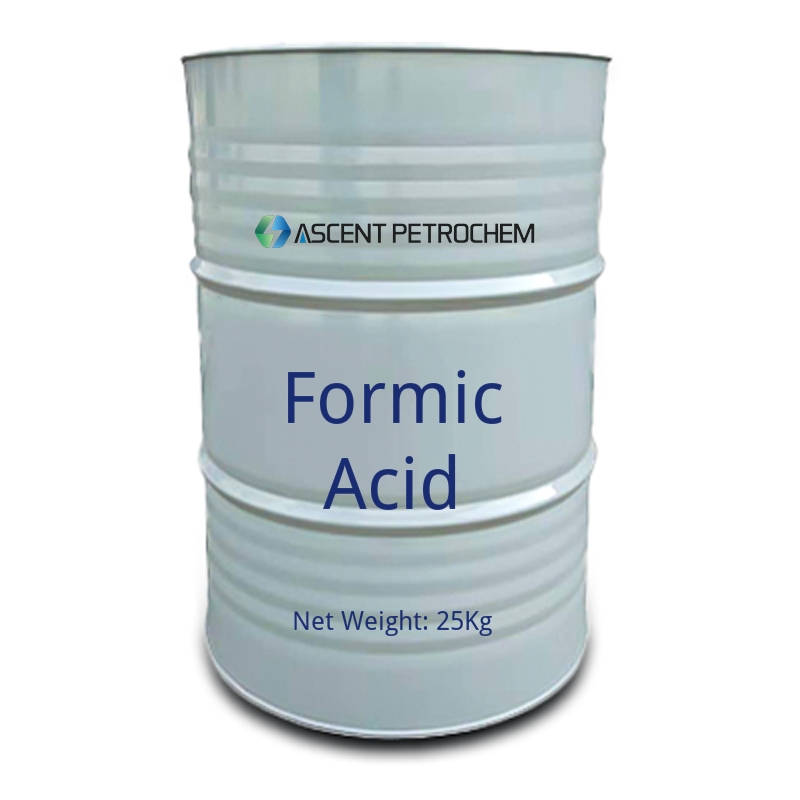
Formic Acid
- Product Name: Formic Acid
- Factroy Site: Yudu County, Ganzhou, Jiangxi, China
- Price Inquiry: sales6@ascent-chem.com
- Manufacturer: Ascent Petrochem Holdings Co., Limited
- CONTACT NOW

- Formic Acid is typically used in formulations when pH and corrosivity must be controlled within specific ranges.
| HS Code | |
| Productname | Formic Acid |
| Chemicalformula | CH2O2 |
| Synonyms | Methanoic acid; Hydrogen carboxylic acid; Formylic acid |
| Casnumber | 64-18-6 |
| Ecnumber | 200-579-1 |
| Unnumber | 1779 |
| Molecularweight | 46.03 g/mol |
| Appearance | Colorless fuming liquid |
| Odor | Pungent, sharp, irritating |
| Density | 1.220 g/cm3 at 20 °C |
| Meltingpoint | 8.4 °C |
| Boilingpoint | 100.8 °C |
| Flashpoint | 69 °C closed cup |
| Autoignitiontemperature | 434 °C |
| Ph | 2.2 for 1% aqueous solution |
| Pka | 3.75 |
| Solubility | Miscible with water, ethanol, ether, acetone |
| Vaporpressure | 35 mmHg at 20 °C |
| Viscosity | 1.57 mPa·s at 25 °C |
| Refractiveindex | 1.3714 at 20 °C |
| Storageconditions | Store in a cool, dry, well-ventilated area away from bases, oxidizers, and ignition sources |
As an accredited Formic Acid factory, we enforce strict quality protocols—every batch undergoes rigorous testing to ensure consistent efficacy and safety standards.
| Packing | Formic acid is packaged in 25-liter polyethylene drums or 250-kilogram plastic containers, with corrosive labels and secure closures. |
| Container Loading (20′ FCL) | Formic acid loaded in a 20′ FCL: UN1779 corrosive liquid, packed in sealed drums/IBCs, secured, labeled, with proper documentation. |
| Shipping | Formic acid is shipped as UN1779, Class 8 corrosive liquid, Packing Group II. It requires acid-resistant, leakproof packaging, corrosive labels, and compliant shipping papers. Keep away from oxidizers, heat, and ignition sources. Transport in well-ventilated, secure conditions under DOT, IMDG, or IATA regulations. |
| Storage | Store formic acid in a cool, dry, well-ventilated area using tightly closed, corrosion-resistant containers such as glass, polyethylene, or PTFE. Keep away from heat, ignition sources, strong bases, oxidizers, and reactive metals. Use secondary containment and acid-resistant cabinets. Protect from freezing by maintaining temperatures above 8°C. Label containers clearly, segregate from incompatible materials, avoid direct sunlight, and inspect regularly. |
| Shelf Life | Formic acid: stable, indefinite shelf life if kept sealed in original container, cool, dry, well-ventilated, away from bases, oxidizers, heat. |
Formic acid (CAS 64-18-6) is supplied to downstream processors as an 85%, 90%, or 94% aqueous solution. The application scopes below correspond to established industrial consumption routes and exclude speculative downstream uses lacking publicly available equipment or regulatory data. Where a processing configuration is not covered by published test results, that limitation is stated explicitly rather than replaced with unverified performance figures.
Ensiling of high-moisture grass under sub-optimal wilting conditions requires rapid pH depression below 4.0 within the first 24–48 h to suppress enterobacterial fermentation and clostridial butyric acid formation. Formic acid 85% addition rates in northern European grass silage systems typically range from 3.0 to 5.0 L/t of fresh forage when dry matter is between 150 and 250 g/kg; for wet grass below 150 g DM/kg, the upper limit may reach 6.0 L/t, while whole-crop maize and whole-crop barley are treated at 2.0 to 4.0 L/t. The acid is injected into the forage harvester or applied at the silage clamp at 1:1 to 1:3 dilution with water, synchronized with chop length 20–50 mm to achieve even distribution. During bunker filling, rolling must deliver 200–250 kg/m³ fresh-matter density before sealing under a two-layer oxygen barrier film. Regulatory compliance within the EU is defined under Regulation (EC) No 1831/2003 for technological silage additives and Regulation (EC) No 183/2005 on feed hygiene; GMP+ FSA International and QS feed schemes require additional residue documentation. In animal nutrition, formic acid functions as a preservative, not as a nutritional additive, and silage stability is measured by residual sugar retention, ammonia-N fraction below 100 g/kg total N, and absence of butyric acid. The critical failure mode in production-scale silage preservation is not acid underdosing but uneven acid distribution in layers above 30 cm when the harvester yield monitor varies by more than 15%. A batch application at the clamp without continuous mixing creates local pH above 4.5, allowing Clostridium tyrobutyricum to survive and produce butyric acid. Terminal product types include dairy grass silage, whole-crop maize silage for beef finisher units, whole-crop barley silage for high-starch ruminant diets, and lucerne/alfalfa silage where dry matter exceeds 350 g/kg.
| Forage type | Harvest dry matter | Formic acid 85% dosing | Target ensiling pH at day 28 |
|---|---|---|---|
| Perennial ryegrass | 150–250 g/kg | 3.0–5.0 L/t | ≤4.0 |
| Wet grass | ≤150 g/kg | 5.0–6.0 L/t | ≤4.0 |
| Whole-crop maize | 280–350 g/kg | 2.0–4.0 L/t | ≤3.8 |
| Whole-crop barley | 300–400 g/kg | 2.5–4.0 L/t | ≤4.0 |
| Lucerne/alfalfa | 320–400 g/kg | 4.0–6.0 L/t | ≤4.2 |
What pH Window Prevents Acid Swelling and Chrome Precipitation in Pickled Pelts?
In beamhouse processing, formic acid is introduced after bating to lower the pelt pH into the pickling range and to convert residual lime into calcium formate, reducing the risk of chromium complex precipitation during subsequent tanning. Typical deliming baths combine 0.3–0.8 wt% formic acid 85% by pelt weight with ammonium sulfate at 1.0–3.0 wt%; bating enzyme activity is terminated below pH 8.2. The pickling float, commonly 50–100% water by pelt weight, is acidified with 0.5–1.2 wt% formic acid 85% and 0.8–1.3 wt% sulfuric acid in the presence of 6–10 wt% sodium chloride to prevent osmotic acid swelling. Formic acid buffers the float around pH 2.8–3.2 because its pKa of 3.75 limits free hydronium ion concentration relative to sulfuric acid alone. Process monitoring uses ISO 4044:2017 for chemical test sample preparation and the applicable IULTCS/IUC pH method for aqueous extract pH measurement; REACH Annex XVII entry 72 applies to certain leather chemical residues in EU-bound articles, but formic acid itself is not restricted under that entry. Terminal products include chrome-tanned wet-blue in bovine shoe upper and furniture grades, vegetable-tanned crust leather after acid pre-treatment, and delimed bated pelts destined for wet-white synthesis tanning.
On production-scale leather drums with internal diameter 2.0–4.5 m and rotation speed 4–8 rpm, the acid must be prediluted at 1:10 with float water and added in three intervals over 30–45 min; a single fast addition can cause a transient pH drop below 2.5 and gel surface defects in the grain. Batch pH is checked at 20–25°C because electrode readings shift with float temperature. After pickling, pelts are held in a chrome tanning float with chromium oxide offer of 6–8%; formic acid residues accelerate basification response, so basification with sodium bicarbonate or magnesium oxide must be delayed until chrome penetration exceeds 85% of cross-section. Premature basification in the presence of residual formic acid causes surface chrome precipitation and poor wet-blue hydrothermal stability below 100°C.
Field latex coagulation shifts the key control variable from acid strength to pH trajectory between ammonia stabilization at pH 9.5–10.0 and coagulum formation at pH 4.5–5.0. Formic acid for coagulating natural rubber latex is typically diluted to 2–5 wt% solution before addition; dosing ranges from 0.3 to 1.2 parts of 85% formic acid per 100 parts dry rubber when the freshly collected latex is first standardized to 15% dry rubber content and screened to remove bark and sand. The acid is added to the diluted latex in a coagulation trough, mixed for 5–10 min, and allowed to stand for 30–120 min before the coagulum is passed through a three-roll mill to produce crumb or sheet. ISO 2004:2017 sets specifications for concentrated natural rubber latex raw material, while the final dry rubber grade is evaluated against ISO 1795 or national SMR/TSR block standards. Formic acid use in this step does not substitute for ammonia preservation in field latex, and buyers of downstream TSR 10, TSR 20, RSS 3, and concentrated latex should be advised that residual acid has no measurable influence on final rubber Mooney viscosity once drying exceeds 105–110°C.
When Exhaust Dyeing of Wool Requires pH Drift Control Without Leveling Agent Overdose
In acid dyeing of wool, polyamide, and silk, formic acid is used as a volatile organic acid to achieve controlled pH drift from slightly alkaline or neutral dyebath conditions to pH 3.5–5.0 during the high-temperature phase of exhaust dyeing. Addition typically ranges from 0.5 to 2.5 g/L of 85% formic acid, or 1–3% owf depending on liquor ratio, dye depth, and fibre blend. Formic acid is preferred over sulfuric acid where low electrolyte damage and minimum fibre yellowing are required; in wool, it reduces acid-catalysed peptide hydrolysis relative to stronger mineral acid at identical bath pH. Processing is performed in softflow, winch, or jig machines at 98°C for wool, with ramped temperature gradients of 1–2°C/min above 70°C to avoid shock setting. Compliance for dyed textile articles is assessed under ISO 105-C06:2010 for colour fastness to domestic and commercial laundering, Oeko-Tex Standard 100 Annex 4 for acid dye residues, and ZDHC MRSL v3.1 for chemical formulations; discharge pH limits under local sewer-use permits typically require neutralization to pH 6.0–9.0 before release. Batch reproducibility is influenced by formic acid volatility; in open winch machines, up to 10–15% of initial dosing can vaporize during the 60–90 min boil cycle, requiring a split addition: 60% at the start and 40% after 30 min at 95°C. Failure to account for this loss produces batch-to-batch shade variation of ΔE greater than 0.8 against the approved standard. Terminal outputs include dyed pure wool worsted fabric for menswear, polyamide 6 and 6.6 tricot for activewear, silk scarves, and wool/nylon carpet yarn.
High-Temperature Carbonate Stimulation Uses Formic Acid Blends to Slow Wormhole Initiation
Matrix acidizing of limestone and dolomite formations with bottomhole static temperatures above 120°C uses formic acid blended with hydrochloric or acetic acid to reduce corrosion rates and maintain wormhole conductivity. Typical working concentrations are 5–10 wt% formic acid in a total acid blend of 10–15 wt%; a 10 wt% formic acid / 5 wt% HCl blend has been used in carbonate wells where unblended 15 wt% HCl would exceed the inhibitor’s thermal degradation threshold. Corrosion inhibition is evaluated according to NACE TM0374-2016 for acid corrosion inhibitors under flow conditions, with acceptance often set at ≤0.05 lb/ft² mass loss over the exposure period at design bottomhole temperature. Formation compatibility and regained permeability are measured by API RP 42 laboratory core flow tests or equivalent damage appraisal protocols. Operational application uses coiled tubing or bullheading at injection rates of 0.5–2.0 bbl/min, with diverter stages placed to treat low-permeability intervals. Spent acid must be flowed back within 24 h to prevent iron formate precipitation and sludge from asphaltenic crude. Formic acid retards reaction rate because its pKa of 3.75 limits free hydronium ion concentration compared with HCl; this delay shifts the wormhole pattern from face dissolution to branched wormholes in calcite, reducing required acid volume. Coreflood tests at confining pressure 1,500–2,500 psi show that formic acid blends may require 1.2–2.0 pore volumes to breakthrough, but the resulting wormhole channels maintain conductivity under closure stress. Published data for blend performance in high-H₂S reservoirs is limited. The terminal output is not a manufactured good but a stimulated carbonate well; downstream outputs include restored oil or gas productivity in dolomite gas storage wells and water shut-off operations.
Calcium Oxalate and Struvite Dissolution in Falling-Film Evaporator CIP Circuits
In dairy and brewery falling-film evaporators, mineral deposits composed of calcium oxalate, calcium phosphate, and struvite resist conventional alkaline and nitric acid clean-in-place sequences. Inhibited formic acid solutions at 5–20 wt% are circulated at 60–80°C for 30–90 min to dissolve these deposits without aggressive attack on AISI 316L or 304 stainless steel; corrosion rate is checked using ASTM G31-72(2017) coupons exposed to the descaling solution for 4–6 h. The terminal pH of the spent descaling solution is typically maintained above 2.5 to protect passivated surfaces, and flow velocity through tube bundles is kept between 1.5 and 2.5 m/s to avoid vapour locking in the tubes. Equipment sanitation after descaling follows 3-A Sanitary Standards for dairy processing equipment and the facility’s HACCP chemical control procedures; residual formic acid is rinsed to conductivity below 50 µS/cm before production. Formic acid forms soluble calcium formate with solubility approximately 16.5 g/100 mL at 20°C, but it may precipitate iron formate in the presence of dissolved ferric ions; descaling of corroded steel surfaces therefore requires pre-passivation with nitric acid or citric acid to remove iron oxide deposits before formic acid circulation. Terminal products include formulated liquid descalers sold to dairy processors, brewery CIP chemicals, and multi-stage food evaporator descaling programs.
Producing Potassium Formate Runway De-icer Through pH-Controlled Neutralisation
Formic acid serves as the acid feedstock for potassium formate, a low-corrosion liquid runway de-icing fluid. In production, 85% formic acid is neutralized with potassium hydroxide solution under controlled temperature 40–60°C to a final pH of 7.0–8.5; the reaction is exothermic and requires jacket cooling in reactors of 5–20 m³ capacity. Stoichiometric consumption is approximately 1.22 kg of potassium hydroxide per 1.0 kg of 100% formic acid, but commercial batches are adjusted to leave 0.1–0.5 wt% residual free acid to buffer against carbon dioxide absorption. The resulting potassium formate solution is concentrated to 50–65 wt% active content and blended with corrosion inhibitors and non-ionic surfactants before qualification testing under SAE AMS 1435 for runway de-icing/anti-icing fluid specification. Aerobic ready biodegradation is commonly assessed by OECD 301F; the terminal product must also pass pavement compatibility and friction coefficient tests specified by the relevant aviation authority. Terminal product types include potassium formate liquid runway de-icer, heat transfer brines for closed-loop HVAC systems, and oilfield drilling fluid additives where formate brines replace chloride-based systems in water-sensitive formations.
Competitive Formic Acid prices that fit your budget—flexible terms and customized quotes for every order.
For samples, pricing, or more information, please contact us at +8618018036652 or mail to sales6@ascent-chem.com.
We will respond to you as soon as possible.
Tel: +8618018036652
Email: sales6@ascent-chem.com
Get Free Quote of Ascent Petrochem Holdings Co., Limited
Flexible payment, competitive price, premium service - Inquire now!
- Formic Acid is manufactured under an ISO 9001 quality system and complies with relevant regulatory requirements.
- COA, SDS/MSDS, and related certificates are available upon request. For certificate requests or inquiries, contact: sales6@ascent-chem.com.
Formic acid is supplied as an aqueous solution of methanoic acid with commercial grades typically designated 85%, 90%, 94%, and 99% by weight. CAS registry number 64-18-6 corresponds to the anhydrous acid; molecular weight is 46.03 g/mol, and the pure compound has a melting point of 8.4°C, boiling point of 100.8°C at 101.3 kPa, density of 1.220 g/cm³ at 20°C, and pKa of 3.75 at 25°C. The 85% technical grade is the standard unit for large-volume industrial use because its freezing point is suppressed to approximately -20°C, whereas anhydrous material solidifies at 8.4°C and requires heated storage in cold climates. Contract specifications for 85% material commonly limit acetic acid to ≤0.6 wt%, chloride below 10 mg/kg, sulfate below 20 mg/kg, and iron below 5 mg/kg; density at 20°C is specified in the range 1.186–1.196 g/cm³, and assay by sodium hydroxide titration is typically 85.0–90.0 wt%. The product differs from acetic and propionic acid both in acid strength and volatility; pKa values are 4.76 for acetic acid and 4.88 for propionic acid, giving formic acid approximately 10 times higher proton-donating capacity than acetic acid at equivalent molar concentration.
What Role Does Formic Acid Play in Leather Pickling and Chrome Tanning?
In leather processing, formic acid is used during pickling to bring delimed pelt to a float pH of 2.8–3.2 before chrome tanning. A typical production formulation meters 0.3–0.8 wt% of 85% formic acid based on fleshed weight in combination with sulfuric acid; sodium formate is added at 0.5–1.0 wt% to buffer the float and prevent acid swelling. Because formic acid has a pKa of 3.75, it penetrates the collagen matrix while the stronger mineral acid lowers surface pH. Operations that substitute acetic acid often extend pickle duration by 20–30 min and experience wider pH drift because acetate has a pKa of 4.76 and weaker buffering at target pickle pH. In tanning drums of 2.0–2.5 m diameter operating at 6–10 rpm, uneven chromium uptake is observed when float pH falls below 2.5; the fault is corrected by formate buffering rather than additional sulfuric acid. Chrome uptake and wet blue fixation are sensitive to basification pH in the range 3.5–4.0, where formate also moderates pH rise. Chemical test samples from wet blue are prepared under ISO 4044:2017 to monitor chromium distribution and pH uniformity.
Carbonate reservoirs with bottomhole static temperatures above 120°C are treated with 10 wt% formic acid as a retarded organic acid alternative to 15 wt% hydrochloric acid where corrosion of 13Cr and 22Cr stainless-steel tubulars exceeds acceptable rates. Stoichiometrically, 100 g of formic acid dissolves 108.7 g of calcium carbonate, compared with 137.3 g of calcium carbonate per 100 g of hydrogen chloride. Field acidizing formulations rarely approach stoichiometric exhaustion because spent acid zones and wormhole channeling limit contact efficiency. Formic acid is selected primarily where hydrochloric acid inhibitors degrade or require uneconomic loading; published data for specific formation mineralogy is limited because core flooding results are reservoir-specific. In tubular pickling, 10–15 wt% formic acid formulations are circulated through completion equipment at 0.5–1.0 m/s to remove mill scale and iron oxide while reducing hydrogen-assisted cracking risk on high-strength steels. The acid is not a substitute for hydrofluoric acid in sandstone matrix stimulation because it does not dissolve silicates.
Feed-Grade Formic Acid Reduces Ammonia Loss from Stored Silage
Formic acid is approved as a silage additive and feed preservative under EU Regulation 1831/2003; in forage ensiling, 85% formic acid is applied at 3–5 L/t fresh crop through harvester-mounted dosing pumps. At that rate, silage pH falls below 4.5 within 24 h, and clostridial fermentation is inhibited. Compared with propionic acid, formic acid acts faster on enterobacteria and clostridia because it is a stronger acid; propionic acid has lower vapor pressure and is adopted where mold inhibition is the primary target. In complete feed, formic acid at 0.3–0.6 wt% lowers buffering capacity and reduces feed pH. Application rates above 6 L/t may reduce silage palatability and increase corrosion of conventional steel chopper parts unless upgraded to stainless steel.
When Formic Acid Replaces Acetic Acid in Esterification and Catalyst Neutralization
As an esterification feedstock, formic acid is used to produce methyl formate, ethyl formate, and butyl formate. Because formic acid is a stronger acid than acetic acid, methanol esterification reaches equilibrium more rapidly under mild conditions; methyl formate has a boiling point of 31.5°C compared with 57°C for methyl acetate, making formate esters more volatile and easier to separate from water by distillation. The lower boiling point also requires vent condensers and refrigerated storage for methyl formate. In processes where acetic acid functions solely as a pH adjuster or catalyst, 94% formic acid can be used at lower molar addition because of its pKa of 3.75; however, formic acid is a reducing agent and can generate carbon monoxide under thermal stress or in the presence of strong dehydrating acids. This reducing behavior differs from acetic acid and must be evaluated before substitution into oxidation-sensitive systems.
Continuous dyeing of polyamide and wool uses 85% formic acid metered at 2–4 g/L to set dyebath pH to 4.0–4.5. Because formic acid has lower molecular weight and higher vapor pressure than acetic acid, it exhausts acid dyes more rapidly at lower temperature and leaves less residual salt on the fabric surface after drying. The pH of aqueous extracts from finished textiles is controlled within commercial tolerances using ISO 3071:2020. Dosing lines for formic acid in continuous dye ranges use 316L stainless steel or titanium because 85% material corrodes carbon steel at bath temperatures above 60°C.
Comparative Acid Strength, Chelation, and Volatility Data
The table below compares selected physical and acid-base properties relevant to substitution decisions among formic acid, acetic acid, and propionic acid. The differences govern process selection: formic acid is used where rapid pH reduction and high volatility are acceptable, acetic acid where lower corrosivity and higher boiling point are required, and propionic acid where fungal control in feedstuffs is the dominant requirement.
| Property | Formic acid | Acetic acid | Propionic acid |
|---|---|---|---|
| pKa at 25°C | 3.75 | 4.76 | 4.88 |
| Molecular weight, g/mol | 46.03 | 60.05 | 74.08 |
| Density at 20°C, g/cm³ | 1.220 | 1.049 | 0.993 |
| Boiling point at 101.3 kPa, °C | 100.8 | 118.1 | 141.2 |
| Vapor pressure at 20°C, hPa | 33 | 15 | 3 |
| Typical commercial concentration, wt% | 85 / 94 / 99 | 99.8 glacial | 99.5 |
Formate ion forms soluble calcium formate and sodium formate, supporting use in descaling products where calcium salt solubility may limit performance. In boiler and heat exchanger descaling, 5–10 wt% formic acid at 40–60°C is circulated through 316L stainless steel plate heat exchangers to dissolve calcium carbonate and iron oxide without chloride-induced pitting. Compared with sulfamic acid, formic acid has a lower pKa and faster scale dissolution at equal temperature, but higher vapor pressure requires closed-loop venting. Compared with citric acid, formic acid dissolves carbonate scale primarily by proton attack rather than metal chelation.
Storage and Venting Are Governed by Decomposition Pressure and Metallurgy
Storage of 85% formic acid uses high-density polyethylene or polypropylene tanks at ambient temperature; 316L stainless steel is used for heat exchangers and continuous feed lines operating above 50°C. Carbon steel is unsuitable because formic acid removes mill scale and generates hydrogen. Alloys containing copper, zinc, or aluminum are incompatible. Decomposition of formic acid to carbon monoxide and water is accelerated by strong mineral acids and by elevated temperatures; storage tanks are therefore equipped with pressure/vacuum vents set at ±0.25 kPa to prevent carbon monoxide accumulation while excluding atmospheric moisture. According to EU CLP Regulation 1272/2008, 85% formic acid is classified as Skin Corr. 1A H314 and Acute Tox. 4 H302; breathing protection with acid gas cartridges is required where vapor concentrations exceed the ACGIH TLV-TWA of 5 ppm. Butyl rubber gauntlets, face shield, and polyvinyl chloride apron are specified because nitrile rubber may have limited breakthrough at 85% concentration.
Sodium formate, calcium formate, and potassium formate are produced by reacting formic acid with the corresponding hydroxide or carbonate. In a continuous neutralization loop, 94% formic acid is fed with sodium hydroxide; heat of neutralization is removed through a graphite plate heat exchanger to maintain the reaction below 80°C. The resulting sodium formate solution is spray-dried to 98.5 wt% product. Formate salts are used in de-icing because potassium formate has a lower eutectic temperature than acetate salts and is less corrosive to carbon steel than chloride salts. Neutralization stoichiometry also explains the feedstock selection: 46.03 kg formic acid per kilomole converts to 68.01 kg sodium formate, compared with 60.05 kg acetic acid per kilomole for sodium acetate.